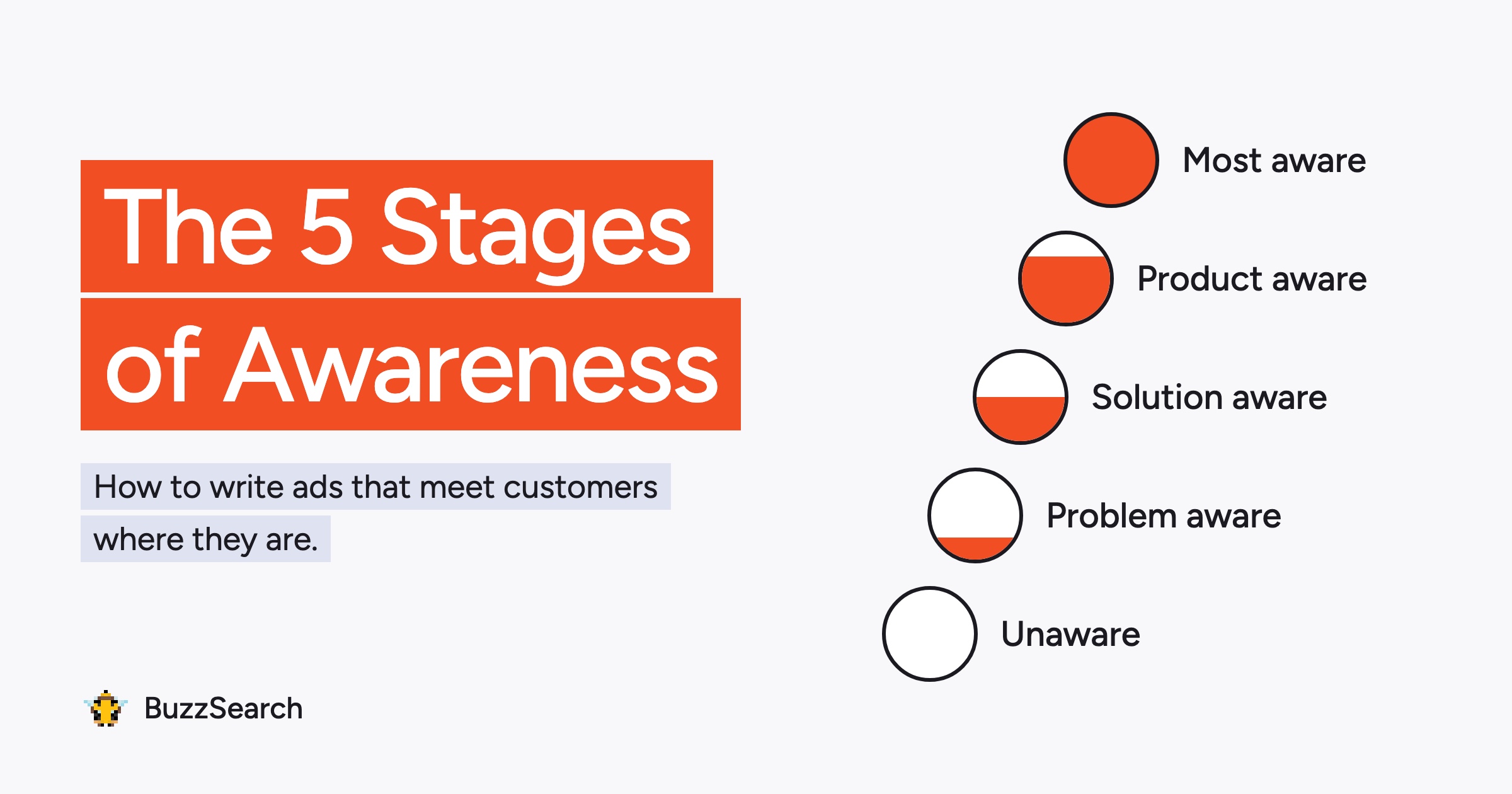
The 5 Stages of Awareness: How to Write Ads That Meet Customers Where They Are

Z is a founder, researcher, and Stanford CS PhD dropout building agentic growth infrastructure for founders who want to move faster than the market. His work spans computer vision research, top 1% CVPR publications, a16z Speedrun, and AI-native growth engineering.
Most ads fail in the first three seconds. The product is rarely the reason. The ad starts a conversation the viewer isn't having.
On Meta today, broad targeting means you rarely pick your audience in the ad manager. Your opening line picks them for you. As media buyer Simon Azman puts it: "messaging selection is your audience selection."
To see what actually works on cold traffic, we analyzed 244 long-running Meta video ads in the BuzzSearch ad library (median runtime: 181 days as of September 2026) and labeled each by what its opening seconds assume the viewer knows.
The result wasn't even close: 85.2% of winning cold ads open by naming a problem, and hide the product.
Yet ad agency founder Dennis Willeboordse tells his students he's "90% sure" most of their ads do the exact opposite: they lead with their product name or a discount. That disconnect is why most ad spend burns out. And the explanation for it was written in 1966.
The Psychological Wall
In chapter 2 of Breakthrough Advertising, copywriter Eugene Schwartz argued that every market sits on a five-step spectrum of awareness, from strangers who don't know they have a problem all the way to buyers ready to pull out their wallet.
Schwartz's rule was blunt: "Each of these stages is separated from the others by a psychological wall. On one side of that wall is indifference; on the other, intense interest."
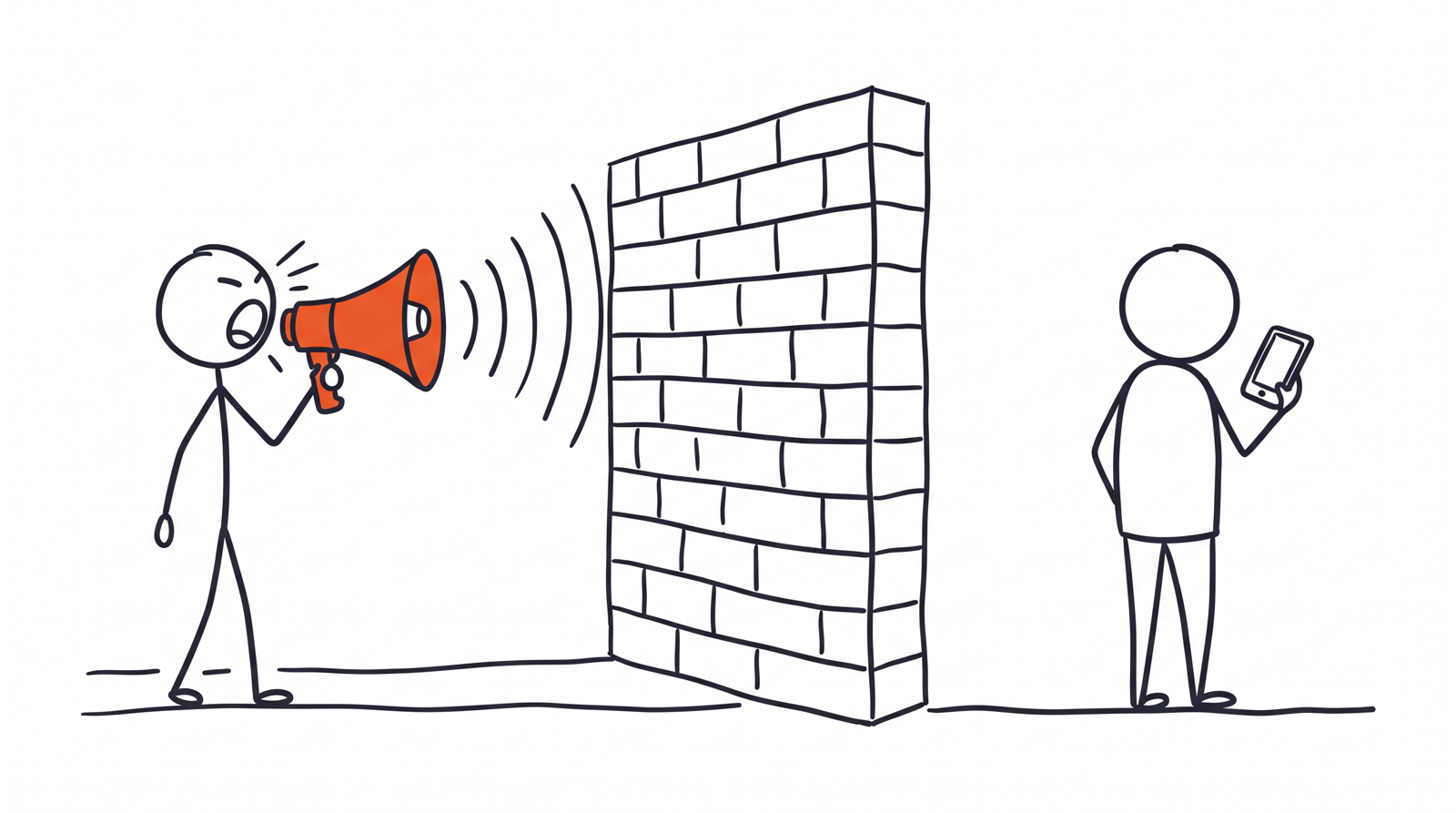
A first line that crushes at one stage dies at another. Pitch a $30 discount to someone who doesn't want your product, and they scroll. Spend 15 seconds explaining a basic problem to someone already comparing brands, and you bore them.
(Note: Schwartz originally numbered these from warmest to coldest, while modern marketers count the opposite way. To keep things clear, we'll use names only and move consistently from coldest to warmest, the actual journey from stranger to buyer.)
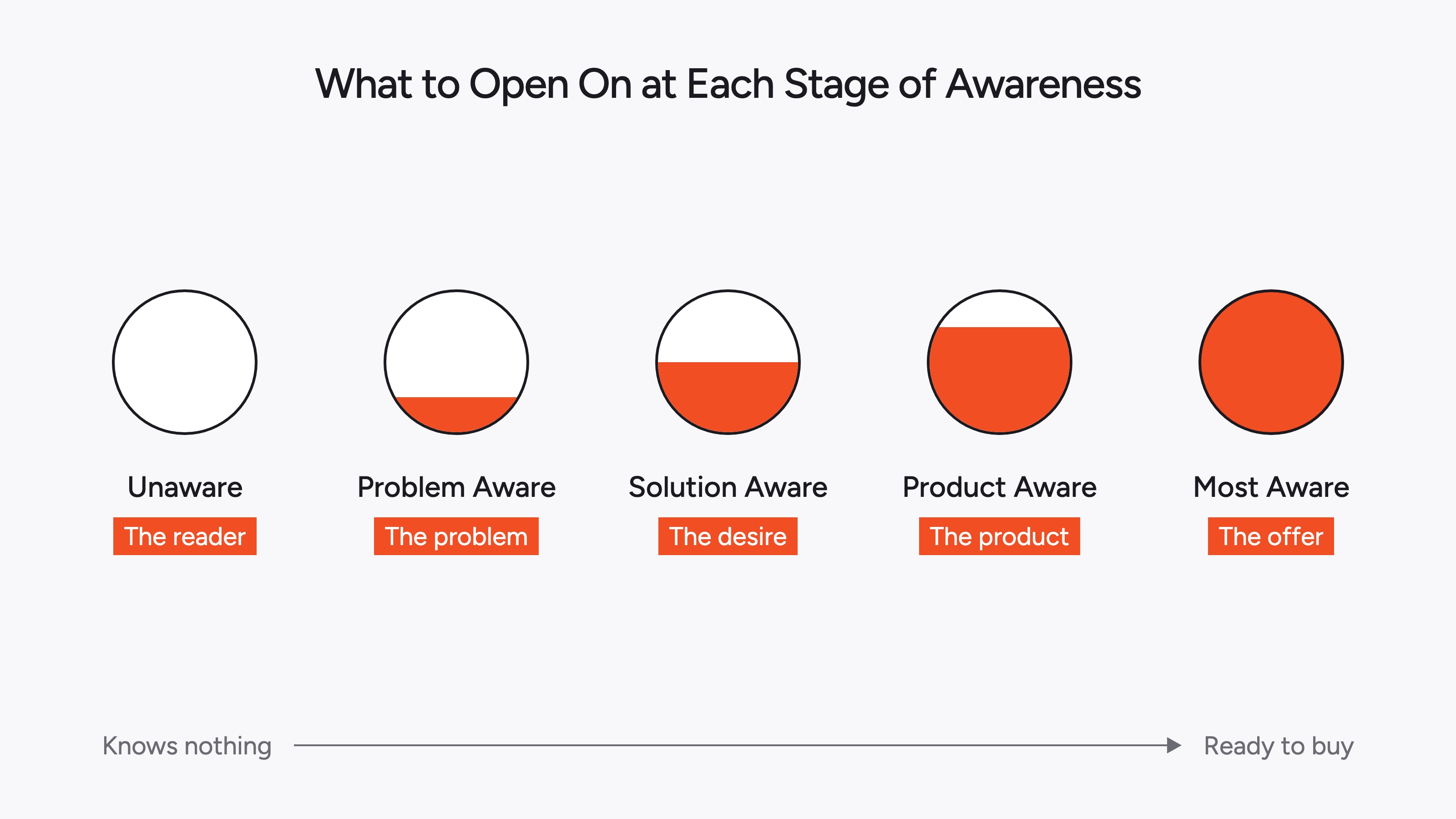
| Stage | What the viewer is thinking | What your first line must be about |
|---|---|---|
| Unaware | "I don't have a problem." | The reader (identity or a shared feeling) |
| Problem aware | "This hurts, and I'm sick of it." | The problem |
| Solution aware | "I want this result, but what actually works?" | The desire |
| Product aware | "I've heard of you, but why should I trust you?" | The product and proof |
| Most aware | "I want it. Give me a reason to buy today." | The price or offer |
What 244 Long-Running Meta Ads Reveal
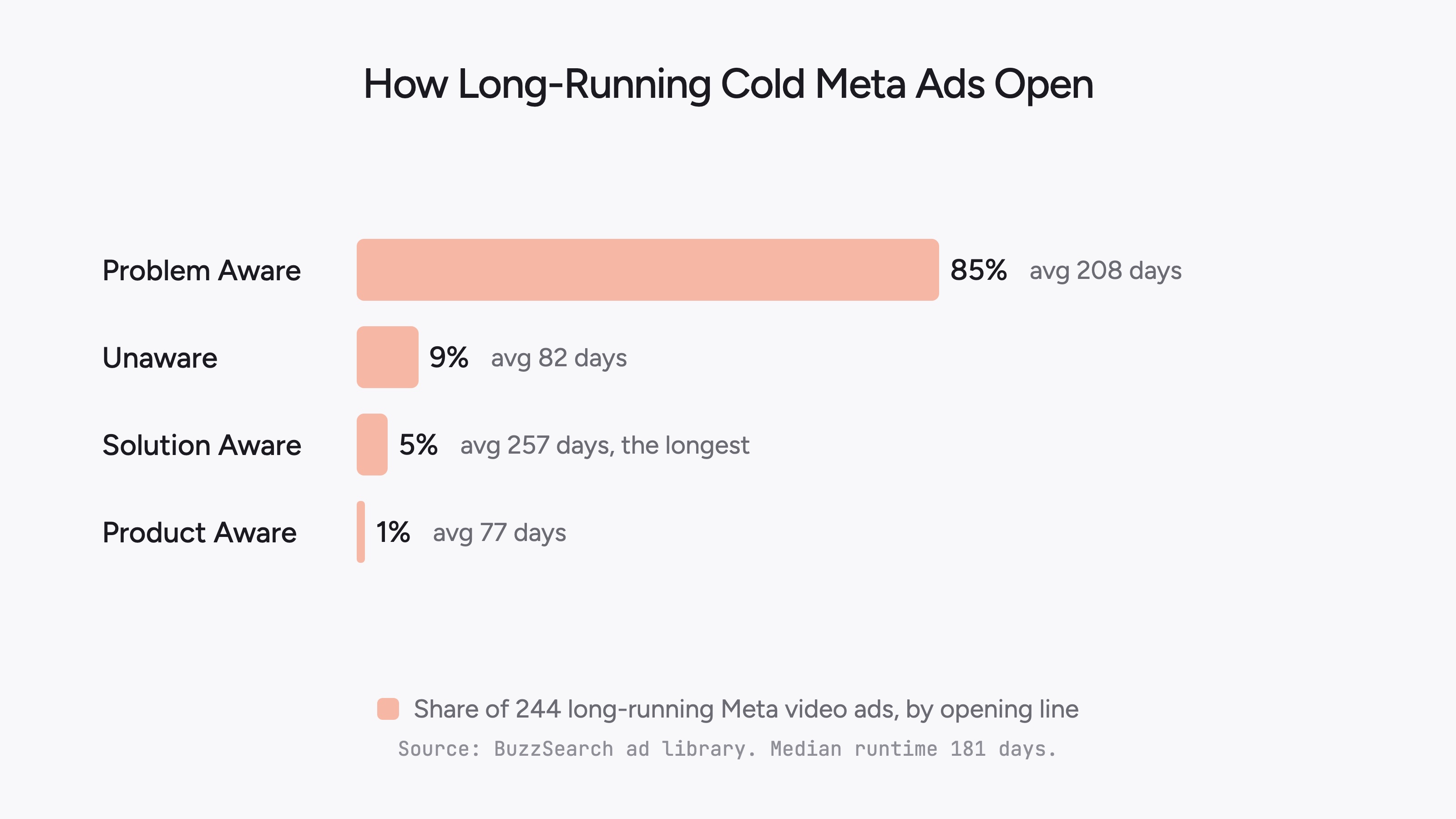
When you map those 244 public Meta video ads against Schwartz's five stages, the distribution is lopsided:
| Stage the opening assumes | Ads | Share | Avg. days running |
|---|---|---|---|
| Unaware | 22 | 9.0% | 82 |
| Problem aware | 208 | 85.2% | 208 |
| Solution aware | 11 | 4.5% | 257 |
| Product aware | 3 | 1.2% | 77 |
| Most aware | 0 | 0% | n/a |
Three takeaways jump off the page:
- Problem aware is the default for cold traffic. 208 of the 244 ads open on a pain point before ever showing the product. If you are advertising to strangers, this is your highest-probability starting point.
- Warm stages live in retargeting. Every ad in this dataset is a public post with comments. Product-aware and most-aware ads usually run as private retargeting campaigns to warm audiences, which is why they barely register here (the library doesn't even carry a dedicated "most aware" tag).
- Solution aware is an underused goldmine. Only 11 ads opened on a pure desire, yet they ran the longest on average at 257 days.
How to Write the First Line for Each Stage
Unaware: Sell Nothing, Describe the Reader
Unaware prospects don't feel a need, or won't admit they have one. By process of elimination, Schwartz wrote: "You cannot mention price, product, function or desire. What do you have left? Your market, of course!"
Your only job in the opening line is to make the right person think, that's me.
- Classic: In 1926, John Caples sold piano lessons with "They Laughed When I Sat Down At the Piano." A direct line about learning piano in five days only reaches people already shopping for lessons; Caples tapped into the universal fear of being underestimated.
- Modern: Smithey Ironware sells cast iron skillets, yet its 185-day Meta ad opens with the founder saying: "When it comes to starting a business, you either jump or you don't jump in." It hooks viewers who identify with the leap of building something from scratch, then bridges to the craft and the pans 13 seconds later.
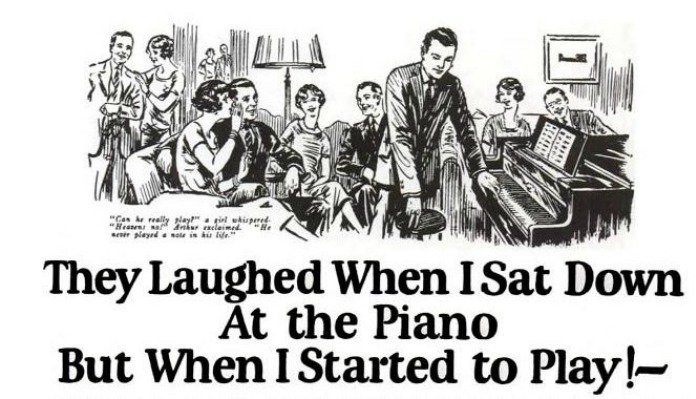
U.S. School of Music, 1926. Copy by John Caples.
The catch: Unaware hooks fail more often than any other. Copywriters treat them as a license to be clever and vague. If the viewer doesn't immediately see themselves in the first sentence, you've lost them.
Problem Aware: Name the Pain and Stop
Problem-aware viewers feel an active frustration, but haven't connected it to your product. Don't warm up. Just name the pain.
- Classic: Schwartz's shortest example is one word: "Corns?" If the problem is vague, sharpen it with specificity. Maxwell Sackheim's "Do you make these mistakes in English?" ran for decades because the single word "these" promised a checklist readers couldn't resist testing themselves against.
- Modern: The Friendly Patch ran a Meta ad for 345 days opening with: "If you suffer from anxiety, just hear me out, okay?" No brand name. No pitch. Just the exact problem in plain English.
Solution Aware: Name the Desire, Hide the Brand
Solution-aware viewers already want a specific outcome, but your brand means nothing to them yet. Drop your name and lead with the result they're chasing.
- Classic: "How to win friends and influence people" states the desire and stops. As Schwartz put it, "Sometimes the simplest statement of the desire is the best."
- Modern: Eternal Perfume Oils ran a Meta ad for 796 days opening with: "This is inspired by Baccarat Rouge 540." Even though it names a famous luxury fragrance, it works as a solution-aware hook: viewers who stop already want that exact scent profile, not Eternal Perfume Oils by name. The brand isn't revealed until the end.
Once the desire hooks them, the body of your ad does two jobs: prove the result is possible, and show that your product is the mechanism that delivers it.
Product Aware: Skip the Discount, Bring Proof
Product-aware prospects know who you are, but they aren't convinced. They doubt it works, or they think a competitor is better. Put your product name in the first line, then immediately give them a concrete reason to believe.
- Classic: David Ogilvy's 1958 Rolls-Royce headline, "At 60 miles an hour, the loudest noise in a Rolls Royce is the electric clock," never claims the car is quiet. It gives you one detail you can hear.
- Modern: Lava Music's Meta ad (running 29 days) opens: "So the Lava Studio was already the most ambitious desktop amp on the market, but it always had one catch." The product name lands in the first breath, and the rest of the ad resolves the catch with a wireless pedal. Notice the price is absent. An unconvinced buyer doesn't need a cheaper offer; they need proof.
Most Aware: Lead With the Offer
Most-aware buyers already want your product. They just need a nudge to buy today. Usually, that's a price drop, a free gift, or a restock alert.
- Classic: A Revere camera headline that simply listed the product, the old price ($149.50), and "Now Only $119.95."
- Modern: A creator's walking pad ad (running 38 days, filed under Product Aware in the library) opens with: "I love this walking pad so much and you guys told me to remind you when it's back in stock." Viewers had already asked for it, so the only message needed was you can buy it now.
Why Winning Lines Eventually Die
Even a perfect first line has an expiration date. Awareness is only half the equation; market sophistication, meaning how many similar promises your audience has already heard, constantly shifts.
Schwartz pointed to a detergent headline asking who else wanted a whiter wash without hard work. It was news once, but after twenty years of "whiter than white" ads, it became background noise. "No market ever stands still," he wrote. When a problem-aware or solution-aware angle gets saturated, you either need a sharper mechanism or a fresh angle (like Schwartz's classic hair-loss pivot: "How a bald-headed barber helped save my hair").
Stop Guessing: Let Your Market Write the First Line
Because awareness lives in the customer's head, the fastest way to find your market's stage is to read what they write when they think no marketer is watching, in Reddit threads and YouTube comments.
A single BuzzSearch query on what women over 40 say about thinning hair surfaces all five stages in their own words:
- Unaware (misreads the symptom): "Honestly I thought my head was shrinking, my glasses kept falling off my head when they used to get lost in my hair" (r/AskWomenOver40, 3 upvotes)
- Problem aware (names the pain): "It's freaking me out. I'm shedding a LOT more hair than normal and it's clear my hair is overall thinner in volume." (r/Xennials, 137 upvotes)
- Solution aware (wants the result, distrusts options): "I'm trying to get my hair back but am scared of causing more damage and am so weary of random 'miracle cures' I see online." (r/30PlusSkinCare, 126 upvotes)
- Product aware (compares brands): "I hated putting oily Rogaine on my hair everything and not being able to leave the house because of my hair. I take Nutrafol or Viviscal and it's working great!" (YouTube comment, 7 likes)
- Most aware (asks where to buy): "I would like to try oral minoxidil. How can I get that?" (YouTube comment, 10 likes)
Look at where the engagement clusters: problem aware (137 upvotes) and solution aware (126 upvotes). That tells you two things immediately. First, an ad for this market should open on sudden shedding or skepticism toward "miracle cures." Second, the comments hand you the exact phrases ("freaking me out," "miracle cures") so your opening line sounds like a real person instead of an ad.
Before You Write Your Next Ad
- Pull 20 real comments from your market on Reddit, YouTube, or TikTok (BuzzSearch pulls these with source links for any topic).
- Sort them into the five stages from unaware to most aware.
- Target the biggest pile. For cold traffic, it will almost always be problem aware or solution aware.
- Restrict your first line to the one thing that stage allows: the reader, the problem, the desire, the product, or the price.
Sources
- Eugene M. Schwartz, Breakthrough Advertising (1966), chapter 2, "Your Prospect's State of Awareness."
- Dennis Willeboordse, "These Principles Generated $150M: 5 Stages of Market Awareness," YouTube, May 2025.
- Simon Azman, "Meta Ads Psychology: The 6 Levels of Awareness (Not 5)," YouTube, November 2026.
- Mason Littlejohn, "5 Levels of Market Awareness For Meta Ads," YouTube, October 2025.
- BuzzSearch ad library: 244 Meta Ad Library video ads labeled by the stage of their opening seconds.
- Customer comments: BuzzSearch query on women over 40 and hair thinning (45 quotes across Reddit, YouTube, and TikTok).